AgInt™: Agricultural Intelligence for Smarter Farmland Investment
An Introduction to Our AGInT way of Thinking
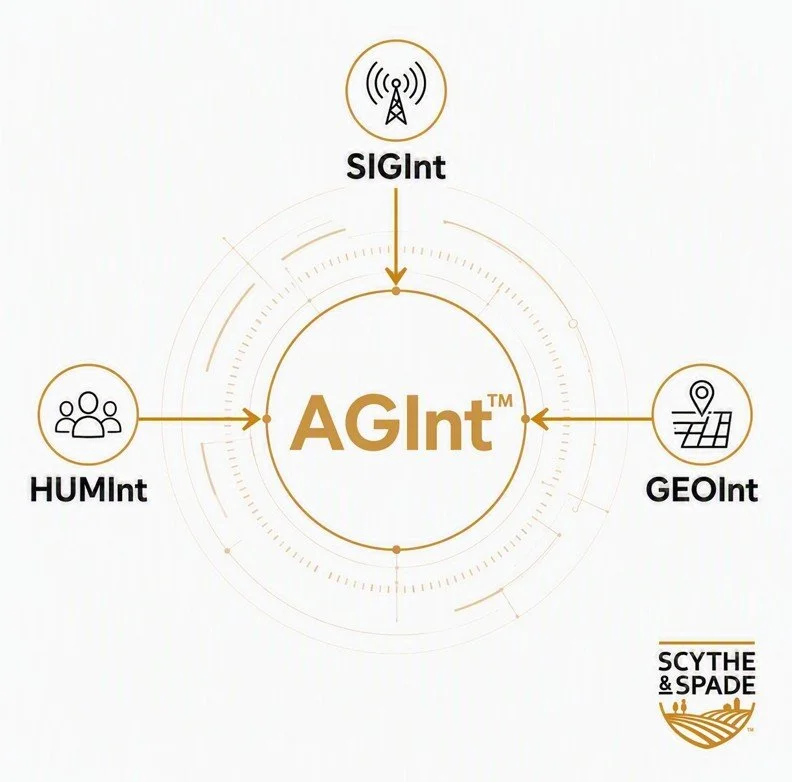
AgInt™, or Agriculture Intelligence, represents a paradigm shift in how Scythe & Spade approaches complex agricultural issues. The process combines technology, data, and the firm’s diverse expertise to simplify challenging questions in agricultural investment and asset management. While many firms can access more data and better technology than ever before, Scythe & Spade’s AgInt™ approach integrates that information with deep practical experience to support better decisions for clients and the firm.
AGint™ Way of Thinking
The foundation for AgInt™ is rooted in the disciplined intelligence processes used in the military. In 2012, while preparing for deployment to eastern Afghanistan, Gavin Doss, our GIS Systems Manager and a U.S. Army geospatial engineer for the Tenth Mountain Division, studied the region’s cultures, key leaders, human networks, infrastructure, and terrain. That preparation helped leaders and intelligence personnel understand which relationships mattered, which areas were strategically important, and how the physical and human environment shaped both opportunities and risks.
Those intelligence briefings did more than create a baseline understanding. They reinforced that intelligence is not static; it is refined continuously as new information becomes available. Military intelligence teams collected updated remote-sensing data, reassessed tribal and human networks, tested intelligence scenarios, and incorporated feedback throughout the deployment. Each intelligence discipline—HUMINT, GEOINT, SIGINT, and all-source analysis—helped verify findings and strengthen subsequent analysis.
Scythe & Spade applies the same disciplined approach to agricultural intelligence. The firm’s decision makers function much like commanders, relying on coordinated streams of information to understand risk, opportunity, and context. Human intelligence, or HUMINT, comes from relationships with farmers, tenants, irrigation district personnel, surveyors, and trusted advisors in each region of operation. Geospatial intelligence, or GEOINT, helps the team understand what is on the ground, locate key infrastructure, and identify critical resources. Market signals, or SIGINT, inform emerging trends. Front-line professionals then combine these intelligence streams with their own expertise to deliver more than due diligence: they produce a holistic view of prospective properties and businesses.
Driving Intelligence: The AGint™ Approach
The US military uses a structured process known as Intelligence Preparation of the Battlefield, or IPB, to develop and refine intelligence during both preparation and execution. IPB follows four steps: define the operational environment, describe environmental factors, evaluate threats, and determine courses of action. Scythe & Spade adapts this framework to agriculture, using the same disciplined sequence to evaluate agricultural investments, assets, and operating environments.
Define the Operational Environment:
Defining the environment narrows the geography and micro-geography under review. This step clarifies the scope of analysis, identifies immediate data needs, activates the firm’s human intelligence network, and determines where additional or updated information is required.
Describe Environmental Factors:
The next step is to describe the environmental factors that shape the opportunity. In a military context, those factors include observation and fields of fire, avenues of approach, key terrain, obstacles, and cover and concealment. In agriculture, Scythe & Spade applies the same concept by analyzing conditions such as soils, water, infrastructure, access, markets, and other physical or operational factors. Although some of these factors are identified while defining the environment, deeper analysis provides greater context and a clearer understanding of their importance.
Evaluate Threats:
The third step is to evaluate threats. Through an agricultural lens, threats may include drought, water rights, curtailments, labor constraints, shifting market trends, legal issues, title concerns, market access, tenant concentration, or government regulation. As the team evaluates these risks, it also identifies knowledge gaps that guide the next iteration of the AgInt™ process.
Opportunities
Opportunities are identified by applying the same intelligence process to determine where a property’s productivity, efficiency, or long-term value can be improved. The team evaluates physical conditions, operational constraints, market signals, and local knowledge to identify practical value-creation opportunities, which may include farm infrastructure improvements, field leveling, removal of trees that are past their productive life, commodity storage, or emerging crop options suited to the region.
Determine Courses of Action:
The final step is to determine courses of action. In the military, courses of action focus on predicting the most likely actions of an adversary. At Scythe & Spade, the process uses the intelligence gathered to support better, more informed decisions. The team identifies every reason not to pursue a transaction, then evaluates whether those risks can be eliminated, mitigated, or accepted if the opportunity still meets the client’s objectives.
Each step in the process informs the next, and each is revisited as newer and more relevant information becomes available. In that sense, the AgInt™ process is never fully complete. After a transaction or due diligence effort, Scythe & Spade reviews what was learned, identifies remaining information gaps, and uses an after-action review process adapted from the military to strengthen future work in each region of operation.
AGInt™
AgInt™ formalizes the way Scythe & Spade already works. The firm approaches projects as a team, combining knowledge, analysis, and debate to make better decisions for clients. It challenges conventional thinking around agricultural issues, simplifies complex questions in farm management and transactions, incorporates new data, and reviews prior diligence efforts to identify lessons learned and opportunities for improvement.
In the coming weeks, Scythe & Spade will explore how each intelligence discipline—GEOINT, HUMINT, and SIGINT—supports the firm’s proprietary AgInt™ process.
#AgInt #AgriculturalIntelligence #FarmlandInvestment #AgriculturalAssetManagement #FarmDueDiligence #AgriculturalDataAnalysis #GISAgriculture #LandIntelligence #FarmRiskManagement #AgInvestmentStrategy #GeospatialIntelligence #AgTech #FarmManagement #SustainableAgriculture #Agribusiness