Continuing the Legacy: Own The Family Farm Without Farming It
Summary
Over the last two generations, millions of acres of U.S. farmland have passed from hands-on operators to the next generation who value the land deeply as their family’s legacy, but no longer farm it themselves. This shift is quietly reshaping American agriculture. According to data from the USDA, nearly 347.8 million acres of US farmland is rented[1], and roughly 87% of that rented land is owned by non-operating landlords.
For many of these families, farmland represents something unique: an income-producing asset, an heirloom, a legacy, and, sometimes, a source of uncertainty. This paper is written for families and family offices who inherited farmland, no longer operate it, and want to understand how to set up their family farm for ongoing and sustainable success. Our goal is not to promote one structure over another, but to explain plainly and honestly the options available, any tradeoffs involved, and the decisions that matter most.
This Paper Frames Four Ideas:
1. Farmland generates returns in two ways: current income & long-term appreciation.
2. Ownership from a distance is now the norm, not the exception. Institutional investors have built durable models families can learn from.
3. Governance matters as much as the tenant operators. The right structures protect both financial outcomes and land stewardship over decades.
4. Transparency in reporting, governance, and farm production records should be a critical component in choosing and building the management model for your property.
The Changing Profile of Farmland Ownership
From Owner-Operator to Owning from a Distance
A generation ago, farmland ownership and farm operations were usually inseparable. Today, that relationship looks a little different. According to statistics from the United States Department of Agriculture:
39.68% of U.S. Farmland is Rented[2]
87% of Rented Farmland is Owned by Non-Operating Landlords
The new reality is that many owners live hundreds, or even thousands, of miles from the land that they own. These owners include retired farmers, surviving spouses, children or grandchildren, trusts/LLCs, individual investors, and family offices. This is not just a temporary trend, this ongoing evolution represents a significant structural shift in how farmland is and will be operated into the future. Driving this structural shift are many factors including an ageing farming demographic, increased capital requirements for operations, and the reality that fewer heirs are financially able or want to operate the farm full-time.
The Coming Transition Wave
This ownership shift is accelerating. Roughly 40% of U.S. farmland is expected to change hands over the next two decades, largely due to the aging owner/operator generation and estate transitions[3]. The average age of principal landowners continues to rise, while replacement operators are few. For families, this means farmland often becomes a financial asset before they have had a chance to build governance systems that fit their individual needs.
There are many operating structures that fit these new realities of modern agriculture. But first, it is important to understand the ways that farmland can generate returns that keep the family engaged and the legacy financially viable into the future.
How Legacy Owners Earn Returns
Two Engines of Return
Farmland returns do not come from rent alone. Returns are driven by two distinct engines:
1. Current Income
a. Cash Rent
b. Crop-Share Income
c. Operating Surplus (If Managed Directly)
2. Long-Term Appreciation
a. Rising Land Values
b. Inflation-Hedging Characteristics
c. Growing Demand of Limited High-Quality Farmland
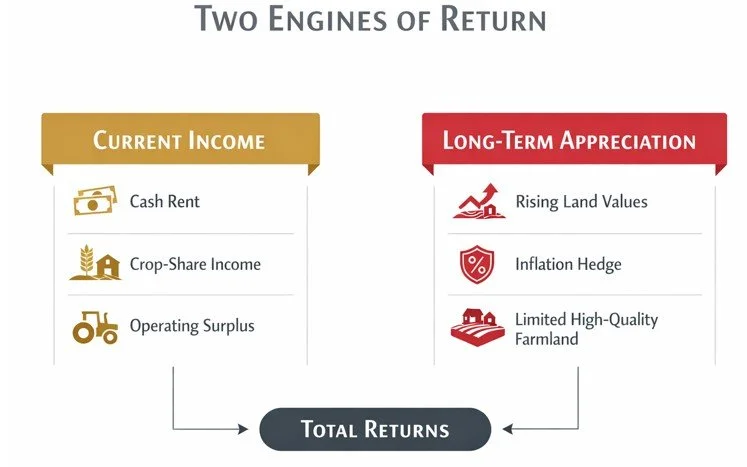
Institutional investors of U.S. farmland have long understood the value and distinction between these two sources of returns, viewing the combination of both as “Total Returns”. Current income is real cash received from the leasing of the farmland assets. The amount of current income received is relative to the farmland region and which crops are being grown. Often tied to the economic conditions surrounding the crop grown; current income will typically fluctuate as these commodity markets move through natural, cyclical market patterns.
Land appreciation values, however, will typically move over longer time horizons with less change. Land appreciation describes how the underlying value of the farmland asset changes year-over-year. The amount of appreciation gained is tied to many factors including general farmland real estate markets, any capital improvement investments, and regular repair, maintenance and improvements throughout the farm. While these returns are not delivered in cash monies until the sale of the asset, they do represent real value gained over time.
Combined, total returns can provide long-term financial stability that allows the family legacy to continue in perpetuity and hedge against external influences such as inflation. Since the early 1990s the NCREIF Farmland Index, which tracks farmland owned by institutional investors, has generated long-term average combined returns around 10% annually over full cycles.
While short-term volatility occurs, farmland’s durability as a real asset stems from income resilience and long-term land value growth.
What Families Often Miss
Many legacy farmland owners focus on rent comparables while overlooking structural drivers:
-Yield does not always equal return.
-A fair annual rent is one that, while providing honest returns to the landowner, can still be sustained by the tenant through fluctuating market conditions.
-Low involvement does not mean low risk.
-A great tenant makes a huge difference. Take time to review prospective tenants not only for operational experience and knowledge, but also for financial credibility. Taking time to carefully choose a great tenant significantly reduces future risk and problems.
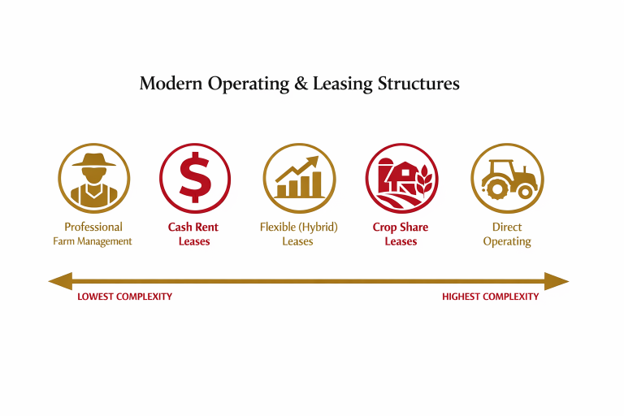
Institutional investors manage their farmland with structured operating systems they design to meet their management preferences and the farm’s individual operating needs. Families can do the same, without having to become farmers or professional farm managers themselves. Here are the most common and useful operating systems for preserving the family legacy, ranked from the lowest to greatest complexity.
Modern Operating & Leasing Structures
Institutional-Style Operating Models (Lowest Complexity)
Professional Farm Management
With a Professional Farm Management operating model a third-party manager is engaged to oversee operations and work as an intermediary between the landowner and land operator. Some of the logistics a farm management company would oversee include:
-Operator selection
-Annual rent collection and accounting
-Budgets and reporting
-Ensure compliance of operational laws and regulations
-Conservation practices
-Capital improvements
-Issues with repairs and maintenance
This is the dominant model used by pension funds and endowments managing billions in farmland assets. Crucially, this structure separates:
-Ownership decisions (Family)
-Operational execution (Manager + Operator)
Why Families Choose It
-Removes administrative burden (and potential conflicts) from family, thus providing more optionality in leasing structures without increasing family involvement.
-Provides more potential optionality in leasing structure without owners increasing their involvement.
-Provides greater oversight into operations and compliance because of farm-level operational knowledge and experience.
-As an unbiased intermediary, farm management firms help provide a healthy separation between business and family.
-Most farm management firms care for many properties, providing the opportunity to benchmark rents, farm production, and land stewardship against other comparable farms.
Challenges
-Farm management companies charge an annual management fee for services that are usually outlined in a Property Management Agreement.
-Since this is a partnership, a careful vetting and due diligence process into each firm is important.
Passive Leasing Structures (Moderate Complexity)
There are three lease structures that are most commonly used. In a Passive Leasing structure, legacy families are responsible for finding a tenant and determining which lease structure best fits their administrative capacity, regional norms, and risk mitigation.
Cash Rent Leases
A fixed annual payment per acre.
Why families use it
- Predictable Income
- Minimal involvement
- Easy administration
- Tradition and inertia; that’s the way we’ve always done it
Tradeoffs
- No upside participation in commodity price or yield increases.
- Limited alignment around soil health or capital investment.
- Requires knowledge of fair market rental rates and changes.
- Requires oversight of tenant and affirmation of care.
Cash rent remains common among absentee owners, particularly where governance capacity is limited.
Crop-Share Lease
Landowner and operator share revenue, and sometimes costs, directly tied to the crops grown on the land. In a crop-share the ownership of the physical crop commodity is divided based on a percentage between the owner and the tenant, with revenue being received with the sale of that crop.
Why families choose it
-Better alignment and upside participation in strong years.
- Risk shared across up/down commodity price and weather cycles.
- Leverages internal knowledge of farming, crops and markets.
- Provides an increased sense of farming participation and closeness to legacy.
Challenges
- Higher annual rent variability.
- Requires stronger oversight, trust, and accounting of crop production yields and total farm revenue.
- Sometimes might include having to directly market your portion of the crop depending on region and lease agreement.
While University and extension research shows that crop-share arrangements can outperform cash rent over 10-year periods, this structure demands clear governance and careful administration.
Flexible (Hybrid) Lease
Base rent plus performance-based upside. These are increasingly common as families seek some predictability and participation. They can align incentives without fully stepping into operations or full crop ownership risk exposure. As a type of blend of both crop-share and cash rent leases, a flex lease allows shared benefits and challenges of both. A base, cash rent is pre-determined and paid annually. If specific commodity prices or specific yield benefits are achieved during the crop year, then tenant will pay an additional rent based on those upsides.
Why Families choose it
- You receive the upside of participating in strong commodity years, without having to worry about farm yields or marketing a crop.
-Base rent provides predictability in annual cash flow.
-Commodity and weather risks are shared between landowner and tenant.
Challenges
-Requires greater regional, crop, and market understanding and monitoring.
-Additional administrative oversight.
Direct Custom Operating via LLC or OpCo (Highest Complexity)
In this structure the family owns land, contracts labor and operators to perform daily farming operations, and owns and markets the final crop commodity.
Why Families Choose it:
-Offers higher theoretical participation in market & yield upsides.
-Complete control over all management practices and decisions.
- Provides a sense of continued family farming heritage.
Challenges
- Assumes all operating and crop marketing risk
- Requires strong governance and administration
- More physical presence and oversight needed
- Requires deep understanding of agricultural production
Risks Families Underestimate
Owning land from a distance is not without risk, but understanding what common risks your farm and family might face goes a long way to being able to plan around them.
Common blind spots include:
-Not having exit provisions or plan in place in the event of a family member wanting or needing to liquidate or pass down their portion of ownership.
-Deferred repair or maintenance in irrigation, drainage, or land & soil improvements.
-Default by tenant on rent or other performance or regulatory requirements.
-Undervalued rental rates, leaving little cash flow returns for any repairs or capital investments needed.
-Overvalued rental rates which place financial strain on tenant that prevents a mutually beneficial, long-term partnership, potentially leading to vacancies or one-season-only rental abuse of the land.
-Short-term tenants often neglect long-term planning needs for soils & infrastructure.
-Poor operating transparency either between tenant and landowner or internally between fractional owners of the land.
-Regulatory and water issues
-Misalignment within family on ownership goals; ie some family members might be more incentivized by income while others priorities wealth or legacy preservation.
Mitigation strategies include:
-A complete due diligence upfront to provide transparency, understanding, and benchmarking of the farmland with all stakeholders.
-Lease agreements crafted with accountability and transparency in mind.
-Multi-year leases tied to stewardship benchmarks.
-Regularly conducted annual and 5-year capital planning sessions that are separate from annual rent negotiations.
-Annual reporting & data sharing with tenant and all internal fractional owners.
-Regular on-site visits with documentation.
Choosing the Right Path for Your Family
When making the decision on how to manage your family’s legacy farm, equal importance must be placed in both the physical factors of the farm and your family’s personal dynamic. Before deciding, it is best to take an internal audit of the family to make sure that everyone understands and is on board with whatever plan is chosen. Below are some great factors that need internal clarity before proceeding:
Decision Filters That Matter
-Desired involvement level
-Strong self-awareness of experience and knowledge in farm operations, governance, regulations, and financial accounting
-Risk tolerance
-Income need vs. growth goals
-Long-term ownership plans, including provisions for an exit strategy
-Stewardship priorities
-Internal decision-making process clarity
Conclusion: Stewardship Through Structure
Farmland can remain a productive, resilient asset for multiple generations to enjoy. But only if ownership structures evolve alongside ownership itself. Modern legacy farmland ownership does not require farming expertise. It requires:
-Clear governance
-Aligned Incentives
-Professional oversight
-Long-term thinking
Families who approach farmland as both land and operating systems consistently protect their farmland legacy better than those who treat it as passive real estate.
[1] 2024 Farmland Ownership and Tenure
[2] Farms and Land in Farms 2025 Survey
[3] America’s farmland is changing hands. What does that mean for the country’s food future? — Center for Responsible Food Business