
Farmland Investment Due Diligence: A Fiduciary Framework for Risk Management and Capital Protection
Introduction: More than a Transaction, A Discipline
Farmland investing is often viewed as one of the more straightforward asset classes a person can own.
It is land. It is tangible. It can generate income, preserve capital, and appreciate over time. On the surface, that sounds simple. But anyone who has spent significant time around farms knows there is a lot more going on beneath the surface.
Farmland is not a standardized real estate asset. No two farms are exactly alike. Each property has its own set of strengths, weaknesses, opportunities, and risks. Those risks may be tied to water, soils, infrastructure, regulatory exposure, crop history, tenant history, operational decisions, drainage, access, or how the land has been used over time. A farm has to be understood not only as it sits today, but also as the result of what has happened on that land over the last several years, decades, or even generations—and what that history could mean for the future.
The goal is not just a closed transaction. The goal is an informed investor, a defensible decision-making process, and an asset strategy built on verified facts rather than assumptions, bias, and misaligned goals between investor and advisor.
With few exceptions, investors putting meaningful capital into farmland, cannot become experts in every issue that can affect a farm. Knowing every agronomic, operational, water, environmental, regulatory, tax, or title issue that may influence the value or risk of a property is the job of the fiduciary. The client should be able to rely on a fiduciary team to identify those issues, explain them clearly, document them well, and provide recommendations that allow the client to make the final decision with confidence.
Our role as a fiduciary is to help clients work through that complexity. That means bringing together experience in acquisitions, dispositions, farm management, and operations. It means using a team-based approach that allows for deeper analysis and verification. And it means having the technical capability and the practical experience to find risks that are not always obvious at first glance.
In a market where incentives are often pointed toward closing transactions, fiduciary discipline requires a different mindset. It means choosing clarity over convenience, verification over assumption, always prioritizing the clients interest over closing a transaction, and long-term outcomes over short-term execution.
This paper outlines that approach.
Fiduciary Duty in Farmland Investing
Fiduciary vs. Agent: A Critical Distinction
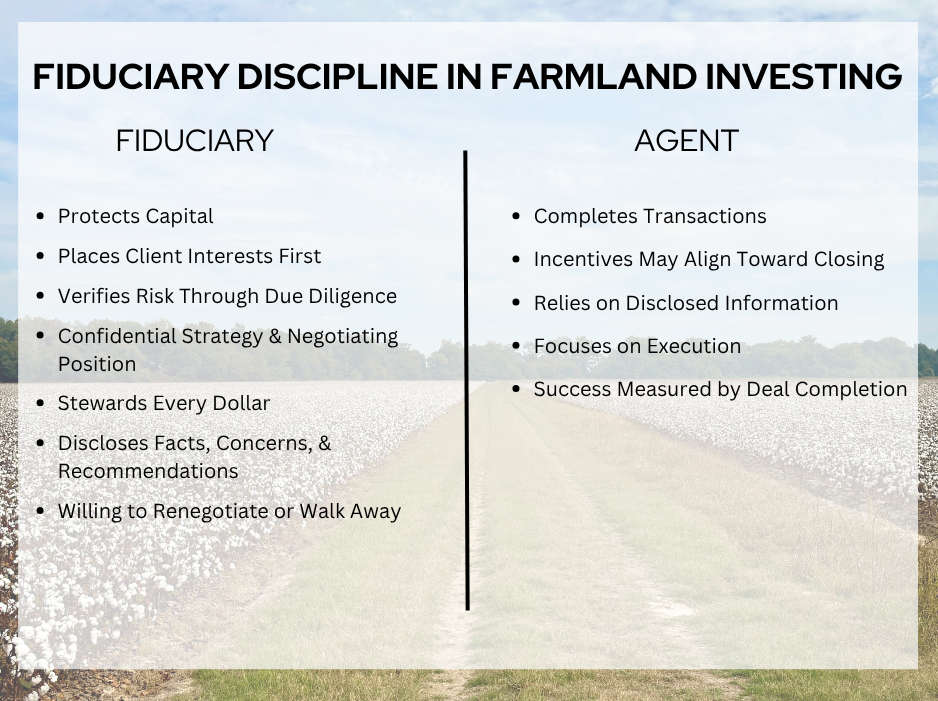
The difference between acting as an agent and acting as a fiduciary is not just a matter of wording. It matters a great deal to the client’s outcome.
Transactions matter. Protecting the client’s capital matters more.
In farmland markets, brokers are often paid when deals close. Sellers usually know more about the property than the buyer. Offering materials may tell part of the story, but they rarely tell the whole story. Offering materials often only point out obvious benefits and rarely give any insight into past or present issues. Without a qualified, independent fiduciary advisor, a buyer can be at a real disadvantage before diligence even begins.
A fiduciary operates from a different obligation. The responsibility is to provide independent analysis, identify conflicts of interest, control confidential information, steward client resources, find and disclose material facts and concerns to the client, and recommend the right course of action—even if that means renegotiating the deal or walking away.
The defining question is not whether the transaction closed. The question is whether the client was protected, informed, and positioned to make the best decision based on verified information.
The Fiduciary Standard: Six Core Duties
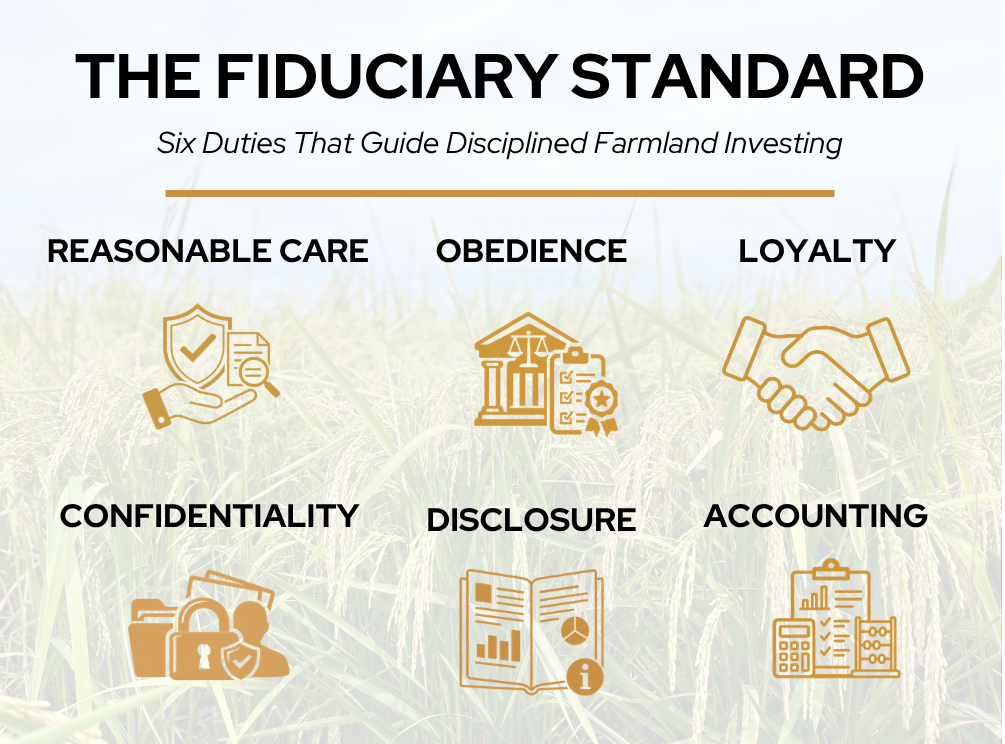
A complete fiduciary standard includes six core duties: Reasonable Care, Obedience, Loyalty, Confidentiality, Accounting, and Disclosure.
These duties do not stand alone. They work together. Reasonable Care without Disclosure leaves the client without the full picture. Loyalty without Confidentiality can weaken the client’s position. Accounting without judgment may track costs, but it does not ensure that money is being spent wisely or in the client’s best interest. Each duty supports the others.
In farmland investing, these duties are not theoretical. They show up in practical ways. They guide how diligence is performed, how third parties are engaged, how findings are documented, how risks are communicated, how money is spent, how information is protected, and how decisions are made.
Reasonable Care
Reasonable Care means taking the time to understand what is really there—not just what has been represented in offering materials, reports, or conversations.
In farmland, that means going beyond what is obvious. It means verifying acreage, questioning assumptions, reviewing water systems, evaluating irrigation and drainage infrastructure, studying soils, reviewing environmental and regulatory exposure, understanding tenant or operator performance, analyzing lease terms, and testing third-party reports against what is actually happening on the ground. This means taking the time on the ground to not only understand the asset, but understand if the history and data align with the situation on the farm.
This is where the fiduciary standard becomes visible. Reasonable Care requires knowing what to look for and being willing to keep looking even when the answer may make the transaction more difficult.
Obedience
Obedience means keeping the client’s objectives at the center of the work—even when there is pressure to close a transaction, meet a timeline, or follow what the market seems to be doing.
A fiduciary must understand what the client is trying to accomplish. For one client, the priority may be current income. For another, it may be long-term appreciation, capital preservation, estate planning, tax strategy, water security, geographic diversification, or eventual disposition.
The advice has to be framed around those objectives. It cannot be framed around the fiduciary’s compensation, the quickest path to closing, or what is most convenient in the moment.
Loyalty
Loyalty means acting in the client’s best interest, with clear communication about risk, cost, and expected outcome.
In practice, loyalty often requires hard conversations. A fiduciary has to be willing to call out issues that may threaten a deal, recommend renegotiation, suggest specialized legal or technical review, or advise that the client walk away entirely. That is true even when the recommendation makes the transaction less likely to close or delays compensation.
The fiduciary’s loyalty is to the client’s outcome—not the transaction.
Confidentiality
Confidentiality matters during diligence with buyers, sellers, third parties, and unrelated parties. Some information discovered during diligence may involve concerns that should stay within the client’s advisory circle until it is properly understood and addressed.
That advisory circle may include attorneys, environmental consultants, water consultants, accountants, investment committee members, or other professionals engaged to protect the client’s interests. Sensitive findings may influence negotiation strategy, pricing, risk mitigation, contract protections, indemnity requests, escrow arrangements, or the decision to proceed or walk away. If that information is shared too broadly or too early, it can weaken the client’s position.
Confidentiality does not mean hiding material facts that should be disclosed. It means managing information appropriately. A fiduciary has to understand the difference between information that should be protected for the client’s strategic benefit and information that must be disclosed because it is material to the property or transaction.
That balance is especially important in farmland because diligence often uncovers technical legal and operational issues—wetlands, water rights, environmental concerns, acreage discrepancies, tenant issues, regulatory questions, or infrastructure problems—that may need careful interpretation before being communicated outside the client’s advisory team.
Accounting
Accounting is a basic part of fiduciary responsibility. Every dollar of the client’s money should be treated as if it were your own. It should be tracked, justified, and spent in a way that benefits and protects the client.
In farmland diligence, costs may include surveys, environmental assessments, water consultants, legal review, mapping work, irrigation inspections, soil analysis, title work, accounting review, and specialized operational investigations. Those expenses can be necessary, but they should never be casual. Each expense should have a purpose tied to understanding risk, protecting value, improving negotiating position, or supporting the client’s decision-making process.
Accounting is not just bookkeeping. It is stewardship. A fiduciary should be able to explain why money was spent, what question the expense was intended to answer, what risk it helped evaluate, and how it contributed to the client’s final decision.
Disclosure
Disclosure is one of the core foundations of due diligence. Making facts, concerns, and reasonable suspicions known and documented for the client is one of the primary reasons fiduciaries are hired.
A fiduciary’s responsibility is not limited to confirmed problems. It also includes identifying inconsistencies, unresolved questions, areas that need more review, and observations that may affect value, risk, management, or transaction structure. A client should not be surprised late in a transaction by something that could have been identified earlier with a disciplined diligence process.
Confidential findings that may be useful in negotiation should always be disclosed to the client. That allows the client to understand the risk, understand the potential leverage, and make informed decisions about price, terms, mitigation, or whether to proceed.
Disclosure also matters when representing a seller. Stating the facts to the other side of a transaction that are material to the property is important when it comes time to sell. The seller’s fiduciary should help identify material facts, support them with evidence, explain what has been done to mitigate issues or risks, and disclose them early enough that they become part of the buyer’s underwriting—not late-stage surprises.
Putting the facts on the table up front can reduce transaction risk. When a buyer enters a transaction knowing the relevant facts, understanding the supporting evidence, and seeing what has been done to address or mitigate concerns, there is less likelihood that the deal falls apart or gets renegotiated because of something discovered just before closing.
Team-Based Due Diligence
It is difficult for farmland due diligence to be executed well by one person alone, no matter how experienced that person may be. There are too many variables involved—agronomic, environmental, regulatory, operational, financial, legal, and historical. Each one matters, and each one can affect the others.
That is why a team-based structure is not just helpful. It is necessary to fulfill the fiduciary obligation of reasonable care.
Effective farmland diligence brings together expertise across:
Acquisitions and transaction management
Farm operations and management
Agronomic analysis and soil evaluation
Water rights and resource assessment
Environmental review and regulatory compliance
Financial modeling and return analysis
Historical mapping and land use analysis
Asset management and long-term planning
No single perspective is enough. The value comes from how those perspectives work together. The ability to cross-reference findings, test assumptions, and identify inconsistencies is often where the most important risks are found.
This is one of the key differences between a fiduciary platform and a group of solo agents. A fiduciary or professional services firm is built around a team of specialized professionals who bring different experience to the farm and the transaction. That team approach allows the firm to evaluate risk from more than one angle before conclusions and recommendations are presented to the client.
In practical terms, a farm is not evaluated only as acreage. It is evaluated as a physical asset, an operating platform, a regulatory profile, a financial investment, a management responsibility, and a potential future disposition. Each lens adds something important. Together, they create a more complete picture.
Historical Mapping and Land Use Analysis
In practice, fiduciary discipline requires methods that go beyond standard diligence. That is especially true when looking at how a farm has changed over time.
One of the most useful and often underutilized tools in farmland due diligence is historical land use mapping. By reviewing aerial imagery and land use records over time, a skilled diligence team can reconstruct the operational, environmental, and regulatory history of a property. That history can reveal risks that may not be obvious from a site visit or document review alone.
Current mapping technology can tell you a lot about how a farm looks today. Historical mapping helps explain how it got there. The two together allow a diligence team to see patterns, inconsistencies, and red flags that might otherwise be missed.
Historical mapping can reveal:
Wetlands that have been drained, farmed, altered, or converted
Prior land uses that may signal soil contamination or chemical residue
Changes in irrigation, drainage, canals, reservoirs, wells, or water infrastructure
Encroachments, boundary changes, or easements not reflected in current title documents
Patterns of crop rotation or land management that inform agronomic risk
Discrepancies between actual farmed acres, FSA records, lease acres, and offering materials
Gaps in continued agricultural use that potentially impact regulatory or program assumptions and qualifications
Critical habitat mapping to identify potential areas of concern related to Threatened and Endangered Species, which could impact current and future operations
The Wetlands and Prior Converted Example
Wetlands are one of the highest-risk areas in farmland acquisition. Federal and state regulations around wetlands can be complicated, and violations—even those that occurred before the current owner—can lead to restoration requirements, penalties, and restricted use.
Historical mapping allows a diligence team to look back and determine whether potential wetland features were present at any point in the property’s history, whether they were altered or converted, and whether the current use lines up with applicable regulations or assumptions.
This is especially important when evaluating whether acres may qualify as prior converted farmland. If wetlands were converted after the relevant deadline, those acres may not meet the definition needed to be treated as prior converted. Likewise, if there have been gaps in continued agricultural use, that history may create risk that the acres do not qualify under the assumptions being made.
These issues are not always visible in current documents. They require a deeper understanding of farms, operations, mapping, and regulatory history than many transaction-focused agents would pursue or verify.
This level of analysis goes well beyond a standard environmental assessment. As a fiduciary, identifying these potential issues and advising the client to engage a reputable environmental consultant, who understands both farming and wetlands regulations, is critical for obtaining a reliable determination and opinion. This can be the difference between a sound investment and a material liability.
The Timing of Due Diligence: A Discipline Over Time
Most people think of due diligence as something that happens when a farm is being purchased or sold. In reality, the best diligence is often treated as an ongoing discipline.
Due diligence is a lot like planting a tree. For a farm asset that has been owned for a long period of time—maybe even generations in the case of many family farms, the best time to perform due diligence was five to ten years ago. Just like the best time to plant a tree was years ago. The second-best time to do both is today.
That matters because many long-held farm assets have never been through a comprehensive, institutional-quality diligence process. The owners may know the farm well from an operational standpoint, but that does not always mean the farm’s risks, documents, environmental history, water systems, acreage, encroachments, access, title, lease structure, and infrastructure have been fully analyzed and documented.
Performing diligence today helps identify issues, mitigate them properly, and document them for future reference. It creates a clear record of what is known, what has been reviewed, what risks exist, what has been addressed, and what should be monitored going forward.
That work can pay for itself by reducing future risk and keeping the asset better prepared for a future sale or transition. When the time comes to sell, refinance, pass on, transfer, restructure, or evaluate the asset, the owner is not starting from scratch. The facts are organized. The risks are known. The supporting evidence is available.
A proactive diligence process also strengthens management. It can inform capital improvement planning, lease negotiations, drainage or irrigation investments, environmental review, tenant performance evaluation, and long-term ownership strategy.
The most effective fiduciary work is not just reactive to a deal. It is preparation for better decisions over time.
Applying the Fiduciary Standard in Practice: Integration with the Client’s Advisory Team
Fiduciary responsibility does not exist in a vacuum. Farmland investments often sit inside a larger planning framework that may include legal structuring, tax strategy, accounting, estate planning, investment committee oversight, lending relationships, family governance, and long-term wealth planning.
The Scythe & Spade team uses the fiduciary elements of Care, Obedience, Loyalty, Confidentiality, Accounting, and Disclosure to work with the client’s existing advisory team and help formulate plans that lead to better outcomes.
That advisory team may include attorneys, accountants, investment committees, environmental consultants, water consultants, estate planning advisors, and other professionals engaged to protect the client’s interests. The purpose is not to replace those advisors. The purpose is to equip them with the farm-level facts, diligence findings, operational context, and risk analysis they need to give better advice.
For attorneys, the diligence process may inform contract language, disclosure schedules, title objections, environmental provisions, indemnities, closing conditions, access agreements, easements, water rights documentation, or risk allocation.
For accountants and tax advisors, farm-level information may influence entity structure, basis considerations, capital improvement planning, income expectations, expense treatment, estate planning, and future disposition strategy.
For investment committees, the fiduciary team’s job is to translate complex technical findings into information that can actually be used to make a decision. Committees need clarity. What are the strengths? What are the weaknesses? What are the opportunities? What are the threats, and can they be addressed? What risks remain, and what recommendation follows from the facts?
For estate planning advisors, farmland diligence can provide important context around long-term ownership, documentation gaps, family objectives, management needs, asset division, transfer planning, and future liquidity options.
This integrated approach helps clients become more informed and successful farmland investors. It supports acquisitions, farm management plans, estate planning, dispositions, and long-term investment decisions. It also creates a shared factual foundation for everyone advising the client.
Supporting the Full Lifecycle of Farmland Ownership
Fiduciary discipline applies across the full lifecycle of farmland ownership. A complete fiduciary approach is not limited to acquisition diligence. It applies to transactions, management, estate planning, investment strategy, and dispositions.
Acquisitions
During acquisitions, fiduciary discipline means identifying and validating risk early, before a significant amount of time is invested and capital is committed. That includes understanding the farm’s physical characteristics, income potential, management requirements, operational limitations, environmental exposure, regulatory profile, and how the asset fits the client’s broader objectives.
Management Plans
During ownership, fiduciary discipline supports lease structure, tenant review, capital planning, infrastructure maintenance, water management, drainage strategy, reporting, compliance, and annual performance evaluation. A farm is not simply bought and held. It has to be actively understood and managed.
Estate Planning and Ownership Structuring
For families and family offices, farmland often sits at the intersection of income, legacy, governance, and generational wealth transfer. A fiduciary who understands the farm’s real-world risks and opportunities can help the client’s attorneys and accountants understand how that asset should be considered in estate planning and ownership structure.
Dispositions
When preparing for a sale, fiduciary discipline means identifying material facts early, documenting the evidence, addressing or mitigating issues where possible, and disclosing information in a way that reduces uncertainty. A buyer who understands the facts going into the deal is less likely to renegotiate or terminate because of late-stage surprises.
Conclusion: Fiduciary Discipline as the Standard
Farmland investing is often treated like a transaction. In reality, it is a discipline that drives constant improvement.
It is a discipline that requires the willingness to challenge assumptions, the patience to uncover what is not immediately visible, and the responsibility to put the client’s interests ahead of everything else.
Fiduciary discipline is not defined by access to opportunities or the ability to close transactions. It is defined by how decisions are made, how risk is understood, how information is protected, how capital is stewarded, how facts are disclosed, and how faithfully the client’s interests are protected throughout the process.
This standard is grounded in Reasonable Care, Obedience, Loyalty, Confidentiality, Accounting, and Disclosure. It requires deep, deliberate, and independent analysis. It requires alignment with the client’s objectives. It requires careful protection of confidential information, disciplined use of client capital, and a commitment to documenting and communicating facts clearly.
Farmland is a complex, evolving asset. It is shaped not only by what it looks like today, but by its operational, environmental, and regulatory history. Understanding those layers requires more than surface-level diligence. It requires intentional investigation, technical expertise, and a structured, team-based approach.
Investors should not be expected to carry that burden alone.
Our role as fiduciaries is to bring clarity to complexity, translate technical detail into informed decision-making, and provide a complete and balanced view of each opportunity, including features and benefits, strengths and weaknesses, and opportunities and threats.
The client remains the ultimate decision-maker. But that decision should be made with full visibility, verified information, and a clear understanding of both the risk and the potential outcome.
In an asset class where overlooked details can materially impact performance, the true measure of a fiduciary is not the number of transactions completed. It is the risks identified, the transparency provided, the capital protected, and the decisions guided with integrity.
In farmland investing, fiduciary discipline is not optional. It is the standard by which decisions should be made and capital should be protected.
Key Takeaways
Fiduciary discipline—not transaction execution—determines long-term investment outcomes.
Investors and operators should not be expected to become experts in farmland risk. That responsibility belongs to their fiduciary.
Farmland is not a standardized asset. Each property requires deep, validated, multi-disciplinary diligence.
A complete fiduciary standard includes Reasonable Care, Obedience, Loyalty, Confidentiality, Accounting, and Disclosure.
Confidentiality protects the client’s strategy, sensitive diligence findings, and negotiating position.
Accounting is stewardship. Every dollar spent should be tracked and tied to protecting or advancing the client’s interests.
Disclosure is the foundation of due diligence and should include facts, concerns, suspicions, and recommendations documented for the client.
Buyer-side disclosure and seller-side disclosure operate differently, but both are critical to reducing risk and improving decisions.
A team-based approach is necessary to fulfill reasonable care in a complex asset class.
A fiduciary’s role includes coordinating with attorneys, accountants, investment committees, environmental consultants, water consultants, and estate planning advisors.
Historical mapping and land use analysis uncover risks that standard diligence may not detect.
Wetland exposure, prior converted status, environmental history, and regulatory liability must be examined across time—not only at the moment of acquisition.
The best time to perform due diligence may have been five to ten years ago. The second-best time is today.
Proactive due diligence can reduce future risk, improve management decisions, support estate planning, and strengthen market readiness for a future sale.
The willingness to renegotiate or walk away from a transaction is one of the clearest signs of true fiduciary representation.