
Institutional Grade Liquidity in Agricultural Assets
The Role of Standardized Due Diligence in Modernizing Farmland Investment for Institutional, Family Office, and High Net Worth investors: Tour Ready – Sale Ready
Executive Summary
Farmland assets in the US represent an up to $3.4 trillion market of which about $71 billion are permanent crops. These remains largely untapped by Institutional, family office, and high net worth individual capital with about 2% - 3% held by institutional investors, in part due to its inherent illiquidity. While technological innovations like fractionalization and tokenization may offer a path toward tradable agricultural securities, the bridge to liquidity relies on validated, standardized, and transparent due diligence. This paper explores how rigorous property, legal, and financial due diligence can transform farmland from a "black box" investment into a more liquid, highly transparent asset class.
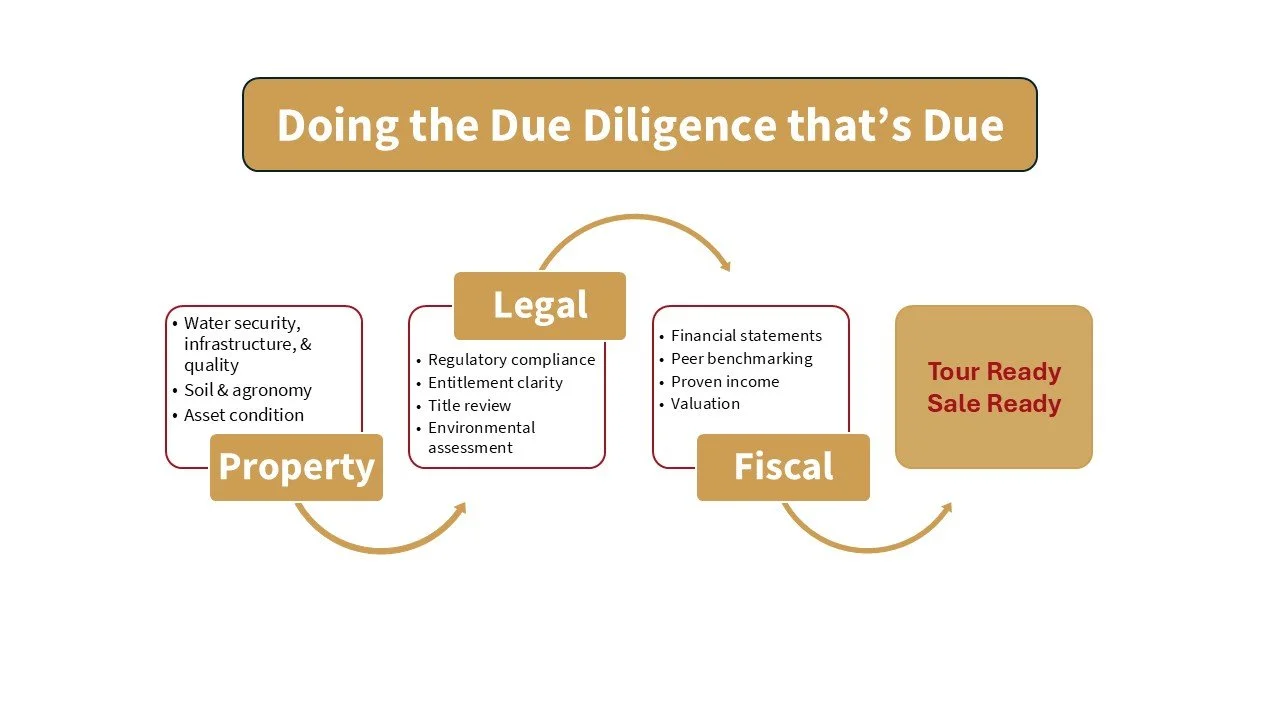
The Liquidity Challenge: Moving Beyond the "Hold Forever" Model
Historically, farmland has been tightly held by individual farmers and is a somewhat unknown asset class outside of agricultural circles. It has been a "buy-and-hold" strategy, often as a generational asset, characterized by 10-to-50-year horizons. Transactions in this asset class have frequently been private and opaque. As such, the market is often perceived to be less liquid than other asset classes, which results in less investment interest despite farmland’s significant potential portfolio upsides, which include diversification, stable returns, and a hedge against inflation. Solving this "Information Asymmetry" problem can attract institutional, family office, and high net worth individual investors to this asset class by creating what we call “Institutional Grade Liquidity”.
Institutional grade liquidity requires that a secondary buyer can acquire an asset with total confidence in the underlying asset's health, legal standing, and historical performance without conducting a prolonged and costly investigation. This is where constantly maintaining updated and validated diligence can help.
Property Level Due Diligence: The Physical Foundation
Farmland is more than just acreage; especially when it’s used to produce specialty crops like tree nuts, citrus or wine grapes. It is a complex biological factory requiring specialized management, reporting, and oversight. Liquidity depends on real-time, verifiable data regarding:
· Water Security, Infrastructure, and Quality: Water rights are a primary driver of value, particularly in irrigation dependent western states but increasingly in the Mississippi Delta region as well. Due diligence must include a robust legal and professional examination of the surface water rights, ground water rights, and in California, Sustainable Groundwater Management Act (SGMA) compliance. This includes an in-depth review of water rights priority, historic availability, reliability, and future water supplies including future curtailments in both surface and ground water because of SGMA.
One must also understand the cost and quality of the water being applied to the crops. These costs include assessments, taxes, pumping costs, application rates, and the capital costs associated with onsite and offsite supply infrastructure such as wells and conveyance methods. Water quality can vary significantly by source and should be assessed from every source point that is supplying irrigation water to the farm.
· Soil and Agronomy: Maintain consistent, historical, digitized records of soil health, pesticide applications, crop yields, and especially permanent crops, crop health. Having these records up to date and readily available for review validates the quality of the asset and creates certainty in a transaction.
· Asset Condition: Utilizing GIS, AI, and other informational technology to monitor, document, and record property level diligence is critical. This helps assess and validate the current and historical condition of farmland to construct an investment thesis and, ultimately, confidence in a transaction.
Legal Due Diligence:
The legal "wrapper" must also be bulletproof for an agricultural asset to quickly and confidently transact. This phase moves beyond simple title insurance:
· Regulatory Compliance: Ensuring all land use permits, water contracts, federal, state and county permits, labor agreements, and environmental mandates are documented and transferable. This requires all stakeholders to work cooperatively along with trusted advisors, and legal counsel.
· Entitlement Clarity: This involves verification that there are no "hidden" encumbrances or long-term lease agreements that would affect value or hinder the exit strategy of an owner. Wine grape crop procurement contracts are a great example of this. They create an encumbrance on the property and many times they remain a cloud on a title even after the contract has expired or been fulfilled.
· Title Review: A title insurance policy (ALTA or CLTA) insures the title against defects, however they contain errors and need close review. A preliminary title report should be prepared on a regular basis to assess and mitigate any title defects and discrepancies in title. This also includes a careful review of the property’s legal description and survey. One MUST reconcile the legal descriptions and all title exception items to the survey. Any discrepancies need to be mitigated prior to transacting. Keeping an up-to-date title that’s clean, and accurate is one of the best practices for creating liquidity.
· Environmental: Phase I Environmental Reports should be viewed as investments in documenting the environmental condition of the property. Success favors the prepared and taking a proactive approach by conducting a professional Phase I to identify and mitigate the environmental issues and concerns of the asset is a good business practice and facilitates liquidity. These issues can be as simple as oil stained soil beneath a pump motor to more series issues such as old trash dumps or chemical spills. Most counterparties require Phase I Environmental Reports as part of their diligence. Engaging a third party to do so prior to transacting creates certainty and speeds up the process. Waiting for a counterparty to do their own Phase I can be risky, time consuming, and costly, especially if it identifies recognized environmental conditions (RECS) that then need to be mitigated and verified during the sales process.
Financial Due Diligence: Standardizing the Bottom Line
Institutional grade liquidity requires a common language for financial performance. This is often the weakest link in family-owned agricultural operations:
· Audit-Ready Financials: Transitioning from "tax-basis" accounting to Reviewed or Audited financial statements that are GAAP-compliant is critical. This is especially true for permanent crops or the sale of ongoing operations.
· Operating Expense Benchmarking: One should compare input costs (labor, fertilizer, energy) against regional averages to prove operational efficiency. It is also a good practice to have a minimum of five years of historical operating costs.
· Proving Up Income Streams: Again with permanent crops, one should provide forward-looking income projections that are supported with historical yields and commodity price information. This data should be supported with actual crop statements from the processor. As with operating expense, the yields and prices should be benchmarked against regional yield and pricing data.
· Valuation Accuracy: While annual appraisals are a good tool to validate value, one should also move toward data-driven valuations conducted on a quarterly basis. Utilizing forward-looking income and expense data, capitalizing that information into valuation, and tracking recent comparable sales in the area are excellent ways to keep the valuation current and accurate. High-frequency valuation is a lubricant for liquidity; an investor cannot trade if they don't know the current value of the asset.
Conclusion: The Path to a Liquid Agricultural Market
The transition of US farmland into more liquid assets is not just a technological shift; it is a transparency shift. By providing institutional grade Property, Legal, and Financial Due Diligence, we remove the friction that currently keeps much of the ~ $3.4 trillion of value locked in private hands and unable to realize its full potential market value.
When an agricultural asset’s water rights are verified, its soil health is digitized, its agronomy is proven, its legal condition is sound, environmental concerns mitigated, and its financials are audited, it becomes a more liquid and transparent financial instrument. This is the future of agricultural investment: a market where capital can move almost as fluidly as the goods these agricultural assets produce.