
Case Study: Rehabilitating Degraded Agricultural Soils Through Aligned Incentives and Disciplined Management
Introduction
Far from just inert matter; healthy soils are the foundation of a productive farmland investment. Soils are a complex biome that requires a dynamic understanding of microbiology, geology, chemistry, hydrology, and plant sciences to properly manage. But while the journey to healthy, living soil is not a small feat, it comes with many rewards. Including increased drought/flood resistance and reduced nutrient costs.
It is no wonder then that this past decade has seen an increased interest in regenerative agriculture, where the focus is on investing in practices that promote soil health. But many sustainability-minded landowners are seeing a mixed bag of results from their soil investments, and sometimes exactly opposite of what was intended.
We recently helped our client through this same frustrating scenario, when after a few years of applying compost and employing no-till methods, a soil fertility test revealed that their fields had very minimal levels of the essential macro nutrients Nitrogen, Phosphorus, and Potassium. The ability of the plant to uptake what macros the soil did possess was further limited by excessively high calcium levels, which “bound-up" what remained of the Phosphorus, Potassium, another essential micronutrients needed to successfully grow any crop.
Client Context / Needs & Issues
Our client was referred to our asset management services by a mutually trusted professional advisor when they expressed that they want help with their small, but complex farmland portfolio. This portfolio consisted of multiple farms located across two states. Each with distinct soils, irrigation systems, agronomic conditions, and operating histories. These farms had historically been owner-operated, but now needed to transition to a tenant-managed system for more stabilized income and reduced day-to-day operational burdens.
This owner valued stewardship of land over purely extractive returns, long-term asset preservation, transparency in management, and predictability. At the same time, there was an expectation that the land should provide competitive, but fair, returns within the constraints of the local agricultural markets.
It was these local market constraints, that proved to be critical to understand. Due to climate and geography, the number of commodities available to grow and market in this portfolio’s region is narrow. Ultimately limiting what returns can be achieved in a fair annual rent. The tenant pool was also thin, making it difficult to find an established and experienced farmer to manage each farm. The value of this tenant partnership would become especially important as the extent of the soil issues became known.
At engagement, other critical unknowns included the true condition of soil health, whether prior regenerative inputs were improving or degrading nutrient balance, the historic performance of the farms, the capital required to restore soils, and whether rehabilitation could be economically justified within a lease framework.
Issues or Problems to Be Solved
Following the transition to tenant management, one farm experienced acute challenges. Within the first year of tenant-based operation, the local hay market price dropped significantly. The tenant, strapped with other unknown obligations in the face of a commodity decline ultimately had to default on the lease right before the farming season began, putting an additional time constraint on this farm’s list of challenges. After an exhaustive search, we were able to find another tenant with more experience in farming and soil management.
Our extensive due diligence process prior to the new tenant’s take over brought to light the farm’s nutrient deficiencies, and excessive calcium issues.
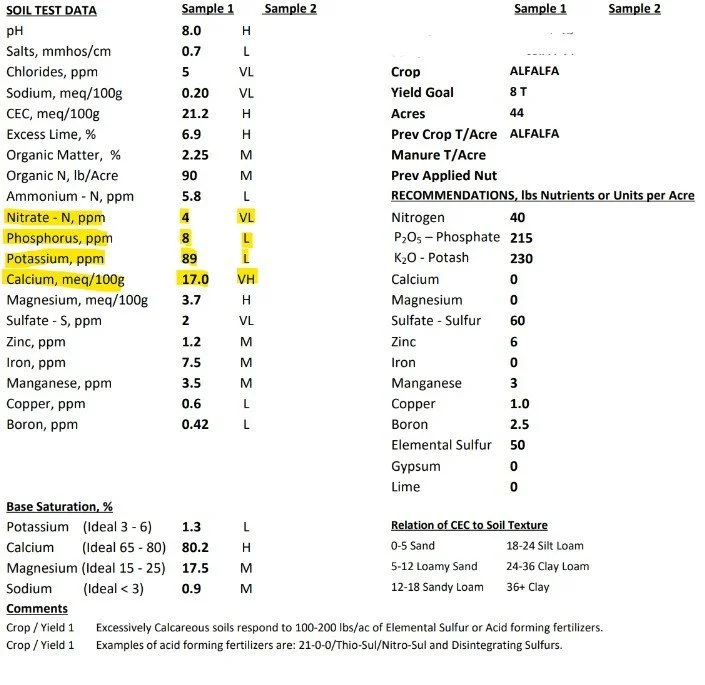
Soils tests provide valuable information needed for a proper nutrient management plan, regardless of which type of fertilizer application you choose to use. As a matter of best practice soil fertility tests should be pulled at least on an annual basis and conducted through the same soils lab for easy comparison. And, as this cautionary tale points out, soil tests should always be a part of any due diligence process.
The effect these nutrient imbalances were having on the alfalfa crop was easily evident. Visible signs of plant stress could be seen throughout the field as long bands of yellow, stunted growth. This plant stress also made the crop more susceptible to pests, and a weevil infestation was further contributing to a significant yield loss.
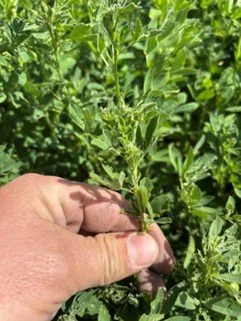
Nutrient deficiencies leave plants especially vulnerable to pests. As early as the beginning of April the weevil infestation was already negatively affecting crop quality and yield. While insecticides were applied, the plants ability to bounce back from this damage depended on our ability to provide the nutrients it needed to do so
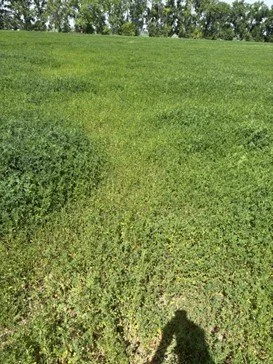
Yellowing, stunted growth, and plant necrosis are all signs of significant nutrient deficiencies
These projected yield losses were such that the tenant feared not being able to break even in the face of depressed crop prices, unless something was done to immediately remedy the soil fertility and pest issues.
On the side of the relationship, the owner was surprised to learn of the soil issues given the yearly application of compost and focus on more regenerative style farming practices. Together, we walked through the soil biology of nutrient management through compost applications and came to a mutual understanding of how miscalculated application methods and environmental constraints had led to the current conditions, and for the need of immediate remediation.
Creating a Win/Win Solution in A Complex Scenario
Our role was to simplify a complex agribusiness issue by integrating agronomy, economics, and governance into a unified strategy. We reframed the issue as a systems challenge; considering both the landowner’s expectations with the needs of the tenant. The landowner wanted a fair return, but also valued the long-term viability of the farm land. The tenant needed healthy soils to raise a profitable crop but could not economically justify the large upfront investment for only a one-year guaranteed lease term.
Using the resources at our disposal, including a comprehensive soil test, our proprietary Lease Rate Indicator analysis, and a lease agreement better structured for mutual benefit, we were able to create a solution that satisfied everyone.
First, an economic analysis was done by Scythe & Spade to determine the cost of depleted soils to both the tenant in yields, and to the landowner in terms of subsidized or temporarily reduced rent. It was apparent that with healthy, fertile soils everyone would win. But how do we cover the interim cost to get there?
Partnering with both a reputable soil lab and an experienced certified crop advisor, we determined what, and how much of each macro & micro nutrient needed to be added back into the soil. Timing of the fertility inputs mattered just as much; with multiple applications spanning across several seasons to obtain the best and most input efficient outcome. The tenant was in the best position to coordinate these applications, and it was decided that the best plan would be to have the tenant purchase and apply these needed fertility inputs in exchange for a three-year secured term and a reduced annual rental rate.
Utilizing our proprietary Lease Rate Indicator, we were able to determine what a fair annual rent would be given the increased length of the lease and the cost of the inputs. The landowner agreed to these terms and we were ready to proceed forward.
Providing Clarity & Accountability with Lease Agreements
In the spirit of “Trust, but Verify” a lease agreement was our best tool to ensure that all parties were held accountable to each part of this new agreement. The necessity and benefits that lease agreements bring to all farm and ranch management scenarios cannot be overstated. In this lease agreement additional provisions were included that outlined the purchase and application of the soil inputs by the tenant, the annual rental rates, a requirement to provide receipts of all fertilizer applications, and a yearly standard of conducting and providing soil tests. It also included turnback language that requires the land at the end of the lease term to have soil fertility levels at, or above, a benchmark standard developed with the aid of a certified crop advisor and the soil laboratory as a healthy and reasonable range. A range was necessary as normal biologic processes, crop plans, weather, and timing of soils test all greatly affect soil fertility test results. It is the tenant's responsibility to manage the soil in such a way that the soil will be returned in these specified conditions.
Outcomes / Conclusions
While this was a soils issue, it is the relationship aspect that cannot be overstated. Hard lines or assumed expectations on either the side of the owner or the tenant would have made any partnership difficult. The world of investment and everyday agriculture can often seem light years apart, making an intermediary between the two so valuable. It is important to have someone who understands the science, finance, vernacular, and economic realities of both sides to help preserve relationships and ensure positive outcomes.
Mixing hard, legal provision of a lease agreement with the inevitable variability that comes with natural biology of crop and soils sciences required a deep understanding of both and a willingness to partner with critical experts.
Within a year, crop yields were back to county average, soil nutrient balance has improved, the tenant-owner relationship was further stabilized by the clear expectations outlined in the lease agreement, and the needs and expectations of all parties continue to be satisfied.
Land degradation can result from misaligned incentives, unverified assumptions, negligence, or un-intentional malpractice. By aligning biology, economics, and governance, this approach transformed a degraded asset into a protected one through structure, not optimism.
A Note About Organic N, lb/acre
Each soils lab will report their soils nutrient results uniquely, underlining the importance of using the same lab for comparable results. For Stukenholtz Labs "Organic N" represents the estimated mineral nitrogen that will be produced by organic matter in the soil during the growing season, in other words, Nitrogen that will become avaliable in the future. This shows that the past applicatons of compost while still providing some nutrient benefits, were not enough for the plant's immediate needs.